
Most enterprises can now show a slide with their AI roadmap on it. Far fewer can show a slide explaining what happens when that roadmap goes wrong — when a model leaks sensitive data, produces a biased outcome, or fails in a way nobody predicted. That gap is where the AI Security & Governance Process lives, and it's no longer a conversation confined to the technology function.
The AI Security & Governance Process refers to the structured discipline of making AI systems secure, governable, and accountable by design — not as an afterthought bolted on after a proof of concept becomes a production system. It used to be framed as a CIO/CISO concern. That framing is now too narrow. When an AI system makes a flawed lending decision, misrepresents financial exposure, or produces an output that ends up in a regulatory filing, the people answering for it are the CEO, the board, internal audit, and the compliance function — not just IT.
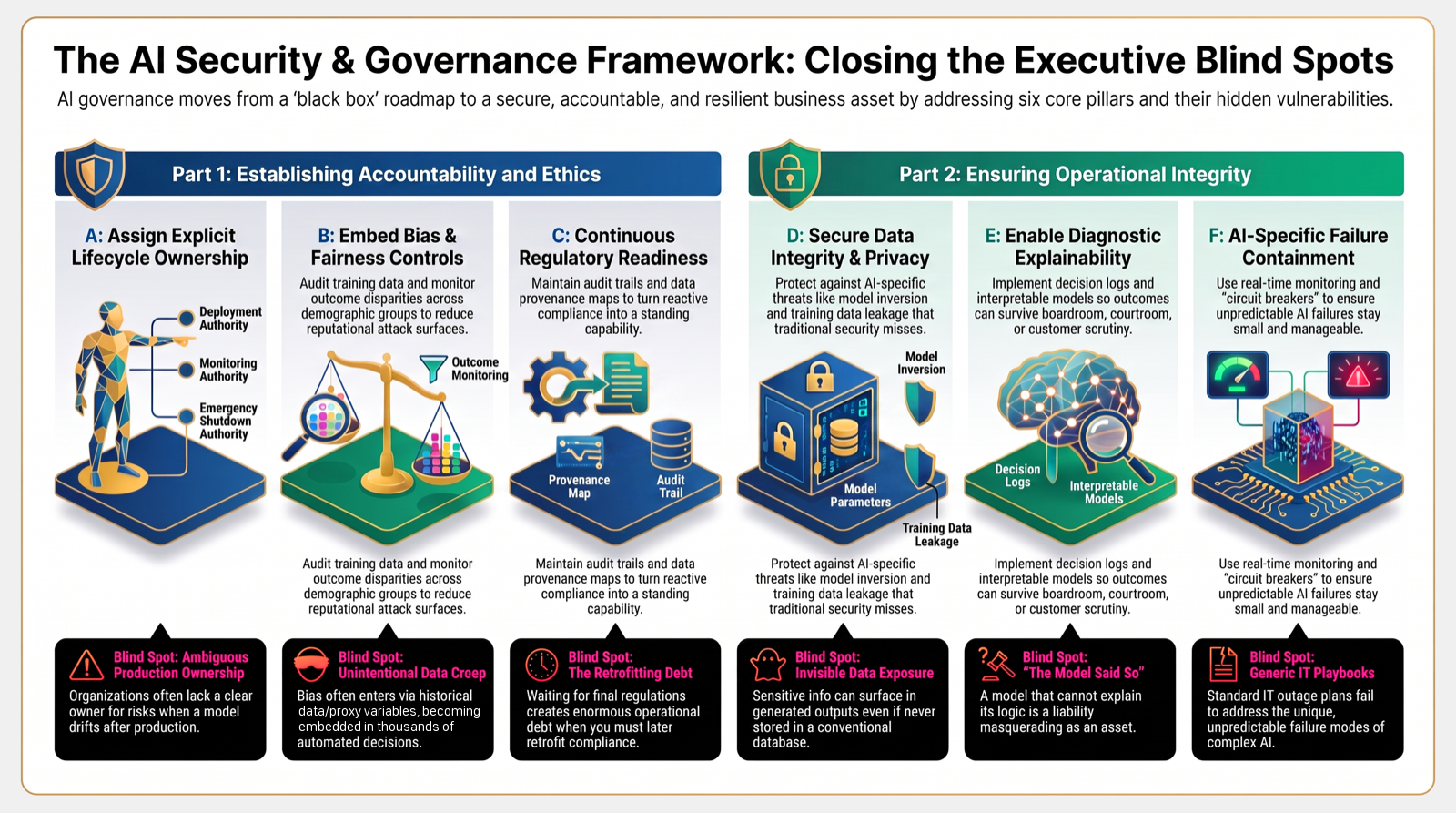
Below is a six-part framework — A through F — for why this process deserves a permanent place on the executive agenda. For each point, we've also flagged the blind spot: the place where organisations think they've covered the risk, but haven't.
A — Accountability
AI projects tend to start with an enthusiastic sponsor and end with an ambiguous owner. Once a model is in production, who is responsible if it drifts, misfires, or produces an outcome that damages the business? Without a security & governance process, accountability is implicit and diffuse — spread across data science, IT, and business units in a way that guarantees no one truly owns the risk.
A mature process assigns explicit ownership at every lifecycle stage: who approves a model for deployment, who monitors it in production, who has authority to pull it offline. This isn't bureaucracy for its own sake — it's the difference between an incident being caught in hours versus discovered by a customer complaint or a regulator's inquiry.
Organisations often assign accountability for building the model but not for decommissioning it. Models quietly retired, replaced, or left running past their intended use case become orphaned risk — nobody owns them because the org chart assumes they no longer exist. Audit committees rarely ask "what AI systems are still running that nobody remembers approving?" — but they should.
B — Bias & Fairness Control
Bias in AI systems is rarely intentional, which is exactly what makes it dangerous. It creeps in through historical training data, proxy variables, or skewed sampling, and by the time it surfaces, it's often already embedded in thousands of decisions — loan approvals, hiring shortlists, customer risk scores.
Security & Governance builds bias testing into the pipeline itself: pre-deployment fairness audits, ongoing monitoring for outcome disparities across demographic groups, and a documented remediation path when disparities are found. This is a security issue as much as an ethics one — an unfair model is an exploitable model, and one that invites regulatory and reputational attack surface the organisation didn't know it had.
Most fairness testing happens once, pre-launch, and is treated as a completed task. But models retrain, data drifts, and a system that passed a fairness audit in month one can develop disparities by month twelve with no code change at all — purely because the population feeding it has shifted. Compliance teams that sign off once and move on are signing off on a snapshot, not an ongoing state.
C — Compliance & Regulatory Readiness
The regulatory landscape around AI is moving faster than most internal governance structures can track. Waiting for regulation to fully solidify before building internal controls is a losing strategy; by the time the rules are final, the operational debt of retrofitting compliance is enormous.
A security & governance process treats compliance as a continuous function, not a project. It maintains audit trails of model decisions, documents training data provenance, and keeps a living map of which regulations apply to which AI use cases across the business. This turns compliance from a reactive scramble into a standing capability.
Compliance functions are typically staffed and trained for rules that already exist. AI risk frequently shows up in the space between existing rules — a use case that isn't explicitly regulated yet but clearly carries regulatory intent once a regulator looks at it. Organisations that only test against current law are structurally unable to see the risk that's six months away from being current law. This is where compliance and audit need to sit with the AI governance function directly, not receive a report from it after the fact.
D — Data Integrity & Privacy
Every AI system is only as trustworthy as the data feeding it, and AI introduces data exposure risks that traditional security programmes weren't built to catch — training data leakage, model inversion attacks, or sensitive information surfacing in generated outputs that were never explicitly stored anywhere in a conventional database.
This is where security teams need to extend their existing data protection posture specifically for AI: encryption and access controls around training datasets, clear consent and data-lineage tracking, and testing for whether a model can be prompted into revealing information it shouldn't. Data integrity isn't just about accuracy — it's about proving, on demand, where the AI's knowledge came from and who was allowed to use it.
Most data governance programmes were built around structured data — databases, fields, records. AI systems, especially generative ones, are frequently fed unstructured data: chat logs, internal documents, emails, call transcripts. That data often was never classified for sensitivity in the first place, because nobody imagined it would end up inside a model. The blind spot isn't the AI system — it's the years of unclassified unstructured data sitting upstream of it.
E — Explainability & Trust
A model that can't explain its own decisions is a liability wearing the costume of an asset. When a customer is denied a service, an employee is flagged by a system, or a board asks why the AI recommended a particular strategic move, "the model said so" is not an answer that survives scrutiny — internal or external.
Explainability mechanisms — decision logs, interpretable model choices where the stakes are high, and clear communication of confidence levels — aren't just technical nice-to-haves. They're what allows an organisation to stand behind its AI in a boardroom, a courtroom, or a customer service call.
Explainability is usually built for the technical audience — a data science team that can read a feature-importance chart. It is rarely built for the audiences who actually need it under pressure: a customer service rep facing an angry customer, a board member facing a journalist, an auditor facing a regulator. An explanation that only a data scientist can understand is not, in any practical sense, an explanation. Few organisations test whether their explainability output actually works for a non-technical stakeholder in a live, adversarial moment.
F — Failure Containment
Every complex system fails eventually; AI is not an exception, and its failure modes are often less predictable than traditional software. The question a security & governance process answers isn't "how do we prevent all failure" — that's not realistic — but "how do we make sure failure stays small."
This means real-time monitoring for anomalous model behaviour, tested rollback procedures, circuit breakers that can automatically pause a system exhibiting erratic output, and a rehearsed incident response plan specific to AI failures rather than a generic IT outage playbook.
Most incident response plans are built around technical failure — the system goes down, outputs errors, stops responding. But AI's most damaging failures are often silent: the system keeps running, keeps producing confident, plausible-sounding output, and is simply wrong. There's no alarm, no outage, no ticket. Silent failure is harder to detect than loud failure, and very few containment plans are built to catch a system that is failing while looking completely healthy.
The Meta Blind Spot: Ownership of the Framework Itself
There's a seventh blind spot that sits above all six: who owns the AI Security & Governance Process as a whole? In most organisations, each of these six areas has a natural home — security owns containment and data integrity, compliance owns regulatory readiness, HR or legal owns bias, IT owns accountability structures. The risk is that everyone owns a slice and no one owns the integration between slices.
This is precisely why the conversation needs to expand beyond CIO and CISO. A CEO needs to know this framework exists because it's ultimately their name on the outcome. Compliance and audit need a seat at the table before deployment, not a report after it. Legal needs visibility into explainability requirements before a dispute forces the issue. Treating AI Security & Governance as a single cross-functional governance process — with one accountable executive sponsor, typically reporting jointly to the CEO and board risk committee — closes the gap that each individual function, however diligent, cannot close alone.
The Executive Takeaway
None of these six elements works in isolation, and none of the blind spots are hypothetical — each one maps to a real category of failure organisations have already experienced elsewhere, just not yet with AI at this scale. Accountability without explainability just means someone owns a problem they can't diagnose. Bias controls without ongoing monitoring catch a snapshot, not a trend. Compliance built only against current law can't see the regulation that's coming.
The value of an AI Security & Governance Process is that it forces these six disciplines — and their blind spots — to be governed together, by a named owner, rather than scattered across teams with different incentives and different blind spots of their own.
For CEOs, this is about protecting the organisation's licence to operate with AI at all. For CIOs and CISOs, it's about recognising that AI has expanded the attack surface and liability surface of the enterprise simultaneously. For compliance and audit, it's about getting into the room before deployment rather than auditing the wreckage after.
The organisations that build this muscle now — and close these blind spots deliberately — will be the ones still trusted to lead with AI five years from now.