For thirty years, the requirements document has functioned as a proxy — a stand-in for something neither side could produce cheaply enough to use directly: a working representation of the system itself. Prose specs, wireframe-heavy BRDs, and thick user-requirement essays exist because building the real thing to react to was expensive, slow, and required specialist skill. So both sides settled for describing it instead, and then spent weeks arguing over whether the description was accurate.
That trade-off is now obsolete, and most vendors haven't noticed.
AI-equipped teams — on both the client and vendor side — can now produce interactive mockups, clickable prototypes, and working UI flows faster than they can write and review the document that used to describe those flows in prose. The artifact that was always the intent behind requirements gathering is now cheaper to produce than its own placeholder. When that happens, continuing to lead with the placeholder isn't rigor. It's inertia dressed up as process discipline.
This isn't an argument for less structure. It's an argument that the structure has been pointing at the wrong artifact for a while, and AI has just made that visible.
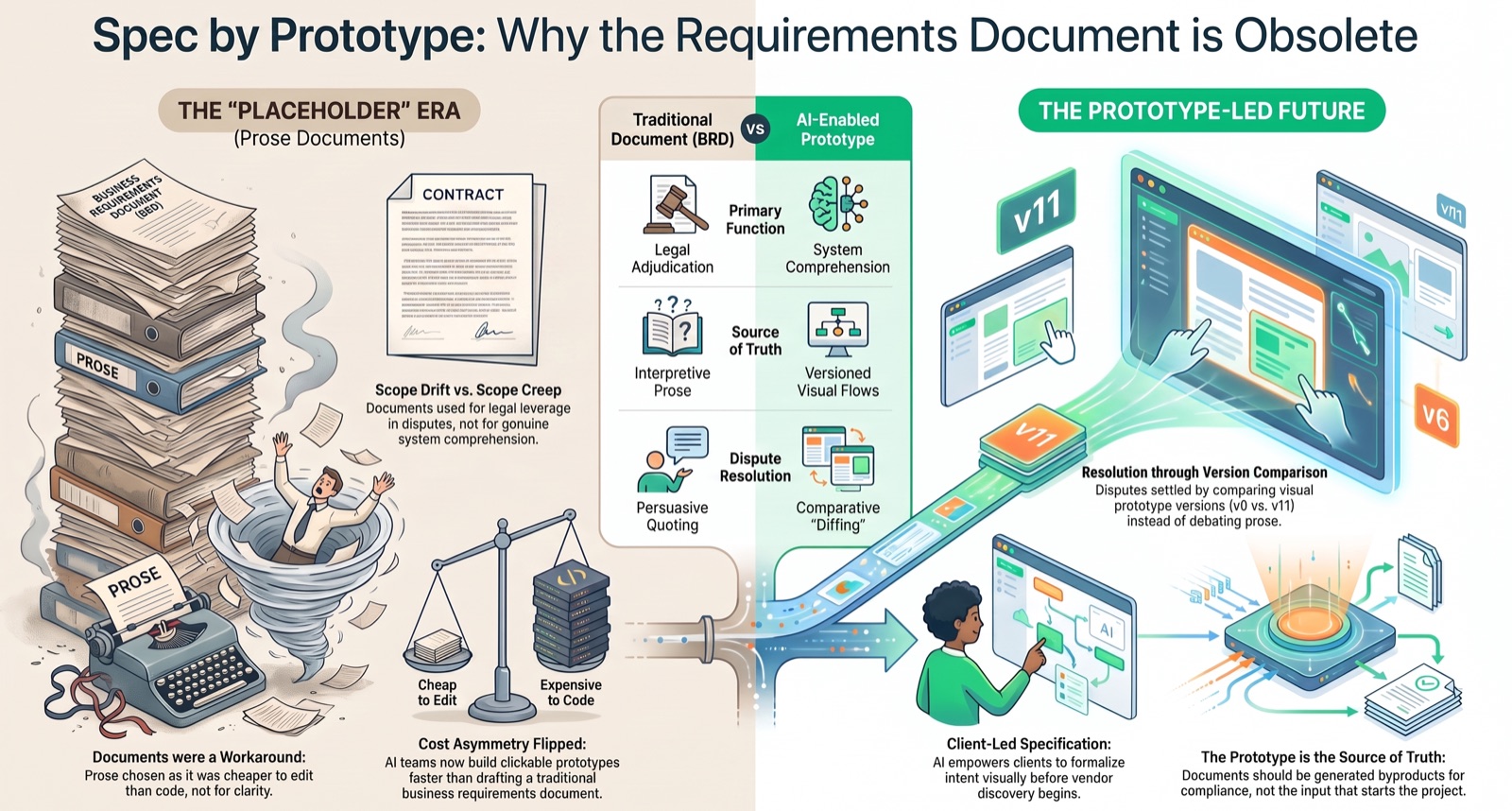
1. The Document Was a Workaround, Not a Requirement
It's worth being honest about why the document-first process took hold in the first place. It wasn't because clients wanted to read essays about their own business. It was because:
- Iteration was expensive. Changing a prototype meant re-briefing developers and waiting days for a new build. Changing a paragraph took minutes. So specification defaulted to the cheaper medium.
- Sign-off needed something static. Contracts and change orders need a fixed reference point, and a document is easy to freeze, version, and initial.
- Vendors needed a scope fence. A written spec draws a defensible boundary around what was promised, which protects margin on fixed-price engagements.
None of these reasons were ever really about communicating intent better. They were about cost containment and risk management, using the best tool available at the time. That tool happened to be prose.
Now, an AI-assisted team can generate a clickable prototype, populate it with realistic data, and walk a stakeholder through actual screens in less time than it takes to draft section 3 of a traditional BRD. The cost asymmetry that justified document-first discovery has flipped. Iteration is now cheaper in the visual medium than in the written one — which means the original justification for the document is gone, even though the habit remains.
Vendors who still open discovery with a requirements questionnaire aren't being careful. They're optimizing for a cost structure that no longer exists.
2. Scope Creep vs. Scope Drift
Watch what actually happens when a scope dispute surfaces mid-project. Nobody re-reads the requirements document to understand the system better. They re-read it for leverage — hunting for the sentence, buried in a subclause, that proves a feature was or wasn't included. Both sides bring their own interpretation, and resolution usually comes down to whoever can quote the document more persuasively.
That's a tell. If the primary remaining function of a requirements document is adjudication rather than comprehension, it has already stopped doing the job it was hired for. It's not a specification anymore. It's a legal artifact wearing a specification's clothing.
A versioned, diffable prototype changes the nature of that argument entirely. Instead of debating what a paragraph meant, both sides can look at what the interface did at a given date, compare it against what it does now, and see the delta directly. Scope stops being an interpretive dispute and becomes a factual one: here is version 4, here is version 9, here is exactly what changed between them and when the change was agreed.
This doesn't eliminate scope creep — clients will still ask for more, and vendors will still need to price it. But it collapses scope drift: the slow, ambiguous disagreement about whether something was always in scope or got added later without anyone quite agreeing to it. A prototype with version history doesn't need to be re-litigated. It just needs to be diffed.
Before: A client asks why bulk order editing isn't in the released module. The vendor points to section 4.3 of the BRD, which describes "order management" without explicitly listing bulk edit as in or out. Both sides read the same sentence and land on opposite conclusions. The dispute escalates to account leads, costs a week, and gets resolved by a goodwill concession rather than a fact.
After: The same question gets answered by pulling up prototype v6, dated the week requirements were signed off, and prototype v11, the current build. Bulk edit isn't present in v6. A comment thread on v9 shows the client requesting it and the vendor flagging it as a change, not an omission. The conversation shifts from "what did the document mean" to "here's the change order for the two days it'll take" — settled in an afternoon, not a week, because the artifact of record shows what was true and when, not what someone once wrote about it.
3. Client-Led, Not Vendor-Led, Specification
The deeper shift here is about who holds the pen.
Prose-based discovery assumed an asymmetry: the client understood the need, but only the vendor had the method to formalize it into something buildable. That asymmetry justified the vendor running discovery workshops, drafting the BRD, and presenting it back to the client for validation. The client's role was to react to the vendor's interpretation of their own business.
AI breaks that asymmetry, and it breaks it from the client's side first. A product owner or business analyst inside a client organization can now sketch user flows, generate mockups, and stand up a working prototype of what they want — often before a vendor is ever brought into the room. They don't need to wait for someone else to formalize their intent. They can formalize it themselves, faster and more accurately than a vendor could infer it from a workshop transcript.
When that's true, a vendor who still opens engagement with a discovery questionnaire isn't leading the process. They're catching up to a client who has already moved past it. Worse, they're signaling — often without meaning to — that their own tooling and ways of working haven't caught up either. In a market where the client is AI-equipped, "we'll run a discovery phase to gather requirements" can read less like diligence and more like a warning sign.
This flips vendor selection into a genuine filter. Clients evaluating SI partners can now ask a pointed question: can you work from our prototype, or do you need us to translate it back into your document format first? Vendors who insist on the latter aren't protecting quality. They're protecting a process that used to be necessary and no longer is.
What This Doesn't Argue For
To be clear, none of this is an argument against rigor, sign-off, or contractual clarity. Those needs are real, and they don't disappear just because the medium changes. Fixed-price engagements still need defensible boundaries. Regulated environments still need auditable records. Teams still need a shared reference point they can point to and say "this is what we agreed."
The argument is about which artifact carries that weight, not whether weight is needed. The prototype — visual, interactive, versioned — can be the source of truth. The document, if it exists at all, should be a generated byproduct of that source, produced for compliance or contractual purposes, not the input that discovery starts from and design has to be reverse-engineered out of.
The Real Question for SI Vendors
The uncomfortable version of this argument is simple: agile was supposed to solve this problem twenty years ago, and for many engagements it didn't, because the ceremony survived while the underlying cost structure that justified document-heavy specification never actually changed. AI is the thing that finally changes it.
The vendors who adapt won't be the ones with the best templates. They'll be the ones willing to let the client's own prototype be the starting point of the engagement, rather than something to be translated, formalized, and handed back in a format the vendor is more comfortable working from. The clients are already there. The question is which vendors notice before it becomes the reason they lose the deal.
For a stage-by-stage look at what prototype-led delivery actually looks like in practice, see our companion piece: The AI-Native Playbook: From Conversation to Sign-Off, Stage by Stage.